LONDON . New york . dubai Intelligence looks better in Heels

WOMEN WHO TREAT THEIR WARDROBE LIKE A FUND
What if your wardrobe performed better than your investment portfolio?
6/24/20265 min read
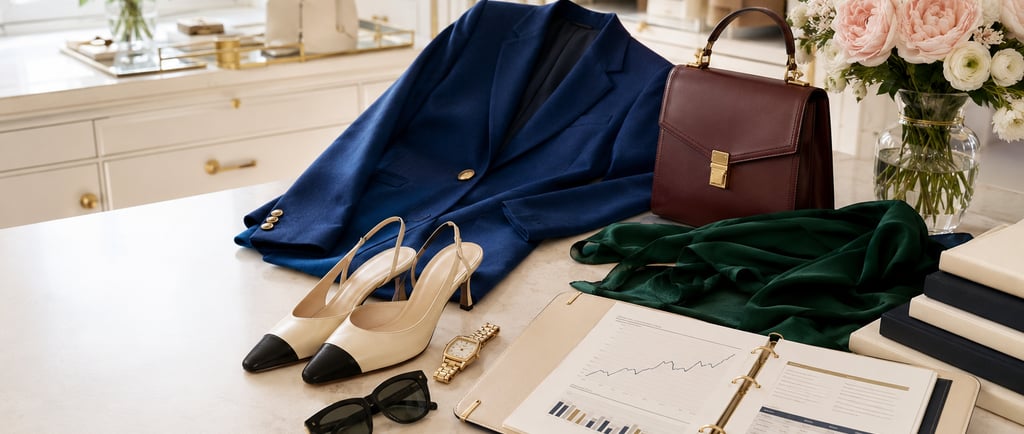
They don't buy fashion. They acquire assets with an exit strategy, a liquidity plan, and a very good eye for undervalued designers.
There is a woman in London — a former derivatives trader, now a consultant — who has not paid full price for a piece of clothing in eleven years. She is also, by her own calculation, up roughly £40,000 on her wardrobe over the same period. She tracks her holdings in a spreadsheet. She knows the resale velocity of every major label she owns. She has a column called expected exit.
"People think I love fashion," she says. "I like fashion fine. What I love is the arbitrage."
She is not alone.
The New Portfolio Dressing
Across financial capitals — London, New York, Dubai, Singapore — a quiet cohort of women has begun approaching their wardrobes with the same analytical rigour they apply to their professional lives. These are not compulsive shoppers rationalizing their habits. They are deliberate acquirers running, in effect, a closed-end fund denominated in leather goods, deadstock knitwear, and pre-collection runway pieces.
They have a framework. They have rules. And increasingly, they have returns to show for it.
The mechanics borrow directly from asset management. You buy undervalued. You hold strategically. You sell into demand. You reinvest. You never, under any circumstances, pay retail for something the market has already priced correctly.
"I think about three things," says one portfolio manager in her late thirties, gesturing at a rail of perhaps forty pieces in her Mayfair flat. "What is this worth to me right now? What will it be worth in three years? And what is my cost to carry it?" The coat she is touching — a double-faced cashmere in cognac, a label most people wouldn't recognise — she bought at a sample sale in 2021 for £180. She has been offered £900 for it twice. She has declined both times. "It's still appreciating," she says simply.
The Asset Classes
Not everything in the wardrobe fund qualifies as an asset. The framework-minded dresser makes sharp distinctions.
Blue chips are the legacy houses — Hermès, Chanel, certain vintages of Prada — whose values are structurally supported by artificial scarcity and generational desire. These are the Birkins and the Boy bags and the early-aughts minimalism pieces that have effectively decoupled from fashion entirely and now trade like commodities. Returns are reliable. Entry costs are punishing. The game here is access and patience, not discovery.
Growth assets are the more interesting play: designers who are critically respected but not yet commercially saturated. The woman who bought Toteme when it was a Swedish secret, or Khaite before the row became a cultural touchstone, or early Aesther Ekme before the waitlists. These require taste, timing, and a tolerance for the risk that the designer never breaks through — or breaks through too completely, flooding the market and collapsing resale premiums.
Distressed assets are the category that separates the serious from the casual. These are the pieces from houses mid-controversy, mid-creative-director-change, or mid-relevance-gap. A Galliano-era Dior, acquired quietly during the years the house spent in reputational exile. A Hedi Slimane Saint Laurent suit bought in 2016, when the aesthetic backlash was loudest, because the silhouette was too good to stay cheap. The thesis: great work survives the news cycle. The risk: sometimes it doesn't.
And then there is deadstock and archive — a category with no Wall Street equivalent. Raw inventory from designers who folded. Pieces acquired directly from sample sales, studio clearances, the occasional estate. The carry cost is zero. The upside is uncapped. The catch is that it requires relationships, proximity, and an almost encyclopedic knowledge of what mattered and why.
The Liquidity Plan
Every serious wardrobe investor knows her exit infrastructure. The resale market, once the slightly embarrassing province of vintage shops and eBay listings, is now a sophisticated, liquid, multi-platform ecosystem.
The Realreal, Vestiaire Collective, and Vinted handle volume. Depop moves the culturally specific. Private networks — WhatsApp groups, Instagram DMs, stylist contacts — command premium prices and zero commission. The most plugged-in sellers know which platforms favor which categories, what photography converts, and how to time a listing to catch trend momentum.
"I sold a coat two hours after Bella Hadid wore something similar," says one woman, without embarrassment. "That's not luck. I'd been watching the cultural signal for weeks."
The concept of liquidity is taken seriously. A wardrobe of illiquid pieces — beautiful things nobody wants to buy — is not a fund. It is a storage problem. The discipline is in knowing the difference between a piece that is rare and a piece that is merely unwanted.
The Due Diligence
Before any acquisition, the framework-minded dresser conducts something resembling research. She checks resale platforms for price history. She reads the critical press for designer trajectory. She pays attention to who is wearing what in which rooms — not because celebrity endorsement is a reliable indicator, but because it is a leading indicator of the retail consumer following behind.
She is looking for the gap between cultural value and market price. That gap is where returns live.
She also examines the object itself with an appraiser's eye. Construction quality. Material provenance. Whether the piece is of-the-moment or genuinely timeless — an important distinction, since the former sells quickly at a premium and then collapses, while the latter accumulates value slowly and holds it almost indefinitely.
"A trend piece is a short position," says the London consultant. "You're borrowing cultural relevance and you need to return it before it depreciates. An archive piece is a long position. Completely different risk profile."
What She Doesn't Do
She doesn't buy because she wants it. Desire is information — useful for flagging categories of interest — but it is not a thesis.
She doesn't buy at full retail unless the item is structurally impossible to find elsewhere, and even then she considers whether the price already reflects the demand she was hoping to exploit.
She doesn't hold out of sentimentality. The sentimental pieces — the ones with memories attached — live in a separate mental category, explicitly excluded from the fund. Mixing the two is how women end up with closets full of expensive things they can't bring themselves to sell and can no longer afford to wear.
She doesn't follow trends. She observes them, the way a geologist observes weather — as surface evidence of deeper structural forces. What is a trend telling you about where the culture is going? Which designers saw it first? Who will still be relevant when it's over?
And she doesn't talk about it much. The financial framing of fashion acquisition still makes people uncomfortable — the implication that dressing beautifully might also be rational. "People want it to be either serious or frivolous," one woman says. "They're not comfortable with both at once."
The Return
Ask these women whether the financial framework has changed how they dress, and they pause.
The answer, almost universally, is: yes, but not in the direction you'd expect. They don't dress more coldly. They dress more precisely. The fund mentality has forced a reckoning with what they actually believe is beautiful, what actually works on their bodies, what they would actually choose if the choice cost something. It has, paradoxically, made them more themselves.
"I own sixty pieces," says the portfolio manager. "I wear all of them. Everything earns its place. Before, I had three hundred things and I dressed like everyone else."
The wardrobe is smaller. The quality is higher. The cost, net of resale, has been negative for four of the last six years.
She is, by any measure, a patient investor with a very long horizon and an exceptionally good eye.
She just happens to wear her portfolio.
The women quoted in this piece requested anonymity, or partial anonymity, as a condition of speaking. Which is itself, perhaps, the most investor-coded thing about all of this.